.png)

Ep. 29: Davide De Michino, Speaker of the Grid Integration & Energy Focus Group at CharIN - V2G, Grid Codes and the Future of E-Mobility
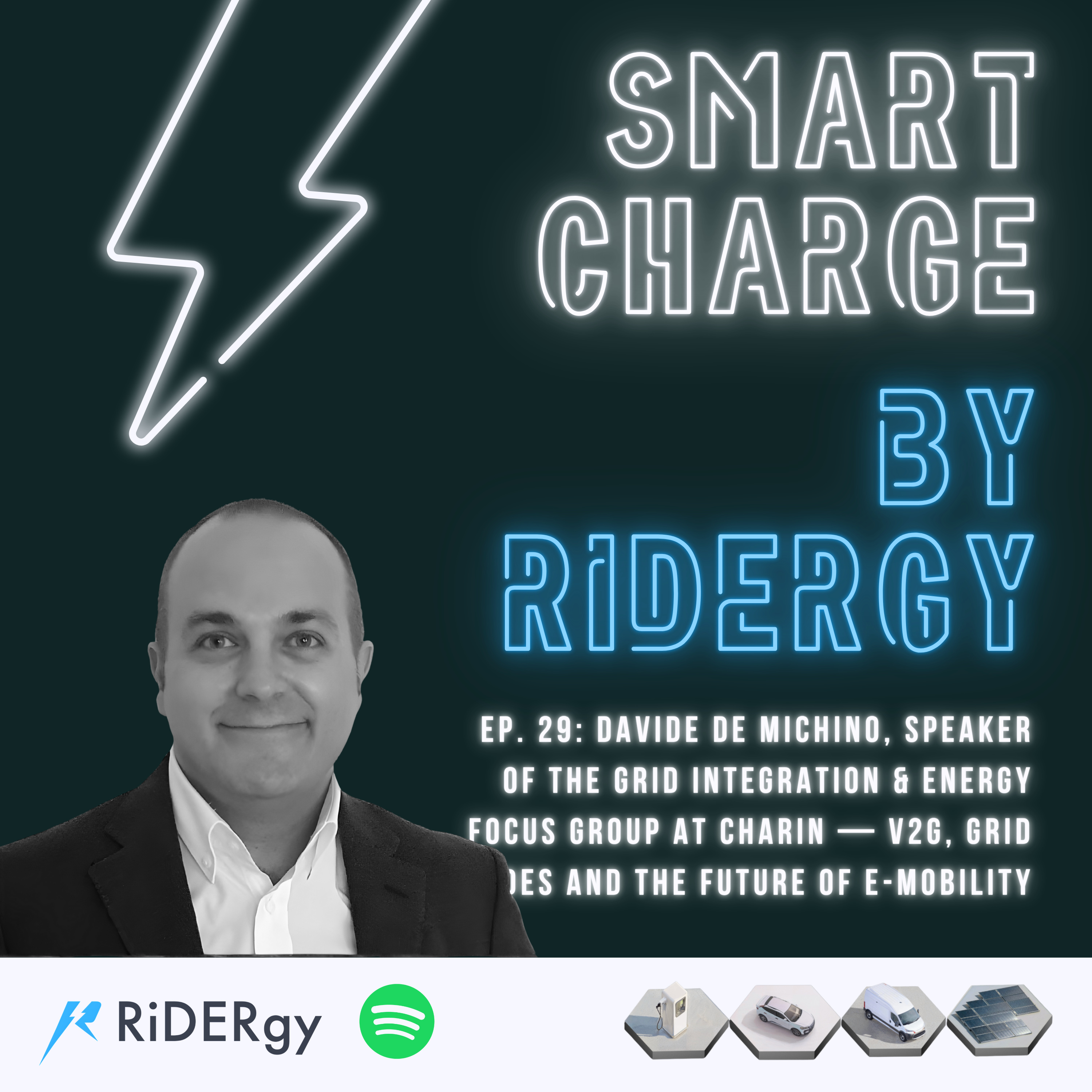
In this episode of Smart Charge by RiDERgy, we sit down with Davide De Michino, who is Global Head of Product Management and Energy Services at Enel X, and a leading voice in global e-mobility and grid integration. Davide also serves as Speaker of the Grid Integration & Energy Focus Group at CharIN and Chair of E-Mobility at SmartEN, placing him at the intersection of utilities, automotive, and regulatory transformation. We explore his two-decade journey at Enel - from energy trading and smart home solutions to leading e-mobility and V2G innovation worldwide. Davide explains how vehicle-grid integration (VGI) is evolving, why CCS and ISO 15118-20 are critical for interoperability, and how standards, regulation and industry coordination will shape the next phase of electrification. Key topics include: - His evolution from trading and retail energy to global e-mobility leadership at Enel X - CharIN’s role in defining global charging standards such as CCS and ISO 15118-20 - The complexity behind V2G adoption: from grid codes to DSO and TSO flexibility markets - The Data Act, RED III and the future of vehicle data access and interoperability - AC vs DC bidirectional charging and why 2026 could mark the commercial breakthrough - Italy’s EV market: strong public infrastructure, high prices and a wave of new EV models - Why AI and heavy-duty vehicle electrification will define the next energy era Davide shares how new European grid codes, flexibility protocols such as OpenADR and IEEE 2030.5, and initiatives like the EU’s Vehicle-to-Grid sandbox proposal will accelerate the transition. He also discusses the cultural shift needed to engage end users - from fleets to households - and why trust, awareness, and simplicity will decide who wins in the new energy ecosystem.
Transcript
Welcome to the Smart Charge by RiDERgy podcast. This is Claudio Geyken, founder and CEO of RiDERgy. This is your show to learn about all things, energy management and smart charging innovation for electric vehicles and fleets.
Welcome back to Smart Charge. Today we're talking with David Demichino, who is in Rome. He's a speaker of CharIN's grid integration Energy Focus Group and works for Enel X Way. The big Italian utility, we dive straight into the how of vehicle grid integration, turning charging sessions into flexibility from peak shaving and time shifting to ancillary services and what really works today with V1G versus what still needs to happen for V2G. Or bidirectional charging, we unpack dynamic tariffs, small asset aggregation, and YPV plus storage plus smart
charging belongs on one playbook. A big chunk is interoperability, the role of CCS and ISO 15118, the North American connector shift, and CharIN's push for global harmonization. Including messy real world challenges in Latin America where mixed imports fragment the market. If you care about making charters parts of the power system, not just power outlets, this one connects policies, standards and products into a single working stack. Plug in. Hello David, how are you today? Fine, thank you. Hi Claudio good that uh you made it. You are
in uh in Rome or where, where do I find you today? Yeah, in Rome, in Rome. That's where you're also based, uh, mostly, right? Yes, normally, yes, um, yeah. OK. Then, before we jump into um detailed EV topics and energy topics, so that the listeners understand who they are listening to, can you introduce yourself, give a bit of a background, and uh, yeah, until you, you arrive to the role where you are today. Yes, sure, so I'm David Demichino. Currently, I'm the global head of global
product management and energy services at Enel X. Um, I also know have different roles, uh, like today I'm participating on behalf of CharIN. I'm the speaker of the grid integration Energy Focus group, but I'm also the immobility, uh, chair inside the, the Smart Tian Association. Uh, our arrival at Enel and in CharIN OK. It's was another revolution. I joined Enel in 2006, so it's almost 20 years, uh, that I'm a part of the Enel group, uh, yes, with different, yeah, very loyal, yeah, uh, with different, um, roles, uh
I would say a form of this time I spent inside. Um, what we call global trading, that is the unit responsible for the operation in the trading market of our power plant in terms of generation, uh, trading meaning on energy markets. OK, so we say intraday ancillary services. So more or less 10 years I was involved in that kind of business. Then I move in in the retail part of Enel following the smart home product before the Italian one, then Enel X was built So I'm
moving Enel X to follow the smart home at a global level. Then in 2020 I'm moving the mobility. Uh, before, just as a senior product manager in the what we call energy services, that was our fancy name for the vehicle grid integration services, then I take the responsibility of this part, then I Take the responsibility of the whole mobility product at Enel X and recently also on other products, so more or less I follow the Beyond commodity solution, including mobility for also B2C and B2B and those
other solutions for B2B like energy monitoring solution, PV storage, and what we call small asset flexibility. Then naturally I was joining, I became a speaker of Uh, grid integration and energy focus group in CharIN, meaning that um. Happen when I take charge of the energy services part in mobility. So there were also um my old previous boss that left this position and so it was a naturally for Enel to candidate me on in CharIN for this role so it's more or less. 2 or 3 years that I helped
to drive this group that is all about. Uh. Vehicle grid integration, OK. Both from a connection point of view, but also from a flexibility service point of view. So V1G vehicle to grid, etc. Well, quite, quite a broad scope of uh expertise that you, that you have, that's quite unique. And, uh, so maybe as a Question that listeners might wonder, are you more interested in the immobility aspects and mobility person or, or more an energy person, or you would say you, you like both fields equally
So as I explained all my background, I would say that my DNA is energy. But naturally, I'm becoming, uh, also mobility guys, meaning that in the other seas I needed to, to enter, uh, to understand a little bit of the, I don't want to say the automotive sector, maybe it's to It's too high. No, it's not that way, but at least to understand what is the mobility and also how the I would say immobility is changing also the automotive uh role in the entire industry and
also, not only energy because it's a revolution for us as utility, uh, uh, but also for, uh, for, for the automotive and that maybe also bigger revolution than, than one in the utility space. Yes, for sure, the, the, the, both spaces are being revolutionized and then they come and merge together. And what's your vision uh related to those two spaces? Uh, you, you have been now around for, for quite some time, so you've seen also the evolution and you're probably closely also monitoring long-term trends. Uh
are there like, is there a vision you, you believe will, will happen in the energy space and, and mobility space? OK, for sure, I have two ears that are, uh, Day by day talking more while I would say when I joined the, uh to, to follow the mobility things, I saw two industries that I would say Was connected but not talking together. Now, now, essentially due to regulation but due to the opportunity in terms of flexibility that the vehicle can give on the grids are to
I would say industry that are, I would say working together. I don't want to say that are collaborating but are working together because both have the, I would say the same goal. Also, if Day by day it seems that we will also compete a little bit in this part of the two industries that not touch each other, so maybe not now, but so there are different examples of that automotive, you know, is. trying to enter in the energy space, obviously they're a natural. Uh, no, migration
since DV, so I think that in the future. They will compete a little bit with us. So we, we see as a utility, we can see this as incumbent on our space a little bit obviously it's a very early stage, but yes. And, and do you think, uh, in terms of the energy space, will it be renewables, mostly and a bit of batteries? Uh, is there like uh uh maybe nuclear, uh, do you have like uh views uh related to where we are heading? And, uh
and then the mobility space, is it gonna be all electric and are there gonna be exceptions here and there? What's, do you have any beliefs there? Let's respond by step by step. So regarding energy, so yeah, renewable for sure. I don't, I don't want to think that someone will change idea, not meaning that. We are inside this revolution, so I don't think that anything will change. Nuclear is different. No. Also nuclear that is put inside the Renewable technology. So that's for sure. We have a role
will have a role in the future. How big I would say that depends on also on the technology evolution. There are different things happening on the in the nuclear space. I'm not, I would say, an expert on that, but there are different technology under development that can change a little bit, you know, not only the perception of the nuclear, but also the value inside the generation. Fleet in a specific country. Inside mobility, yeah, that's a little bit interesting. Passenger vehicles, sure, no, no matter what will
be battery vehicles, so there, there is no dabs on that. It's only a question of time. A couple of years ago, I would say only no maybe hydrogen on heavy duty vehicles will have space. To be honest, no, seeing the automotive space and the main truck manufacturer. It seems clear that it would be also battery driven, not the heavy duty vehicle. I think where the decision has not been taken is Marin. Well I think, uh. Battery can have a role, but let's see. So there are
different examples in Norway like ferries, that is a reality, electrified, but long haul, long haul cargo. Let's see. OK, uh, not yet, no, I think that will be challenging to be battery. So maybe hydrogen can, can take a part of this mix. Um. Then, uh. Aerospace, I don't know. OK. Uh, I would say I'm not a big expert. I saw some, uh, research project about battery airplane, uh, that are in the first phase of the project. Let's see. I, I, I don't know, to be honest
It's, uh, something really at the early stage, uh, you know, maybe also. Hydrogen can, uh, can play a little bit of role, no. On that, who, who knows, yeah. And uh in terms of more day to day topics, how can we imagine what are the topics that are mostly on your mind? But you're dealing with most, meaning that. Uh. As a, as a chain known reference person of this, I think that there are. A couple of technical points, a couple of regulatory points that are Usual
on our table, one is all the, the new amendment of the grid codes in terms of connection of the physical asset on the on the electricity grid. So there are the demand connection and the requests for generator that are the two main dossier under amendment and all the industry is working since I would say now maybe 2 years on that. This will change will change a lot of things, especially for the rest of a generator where they're putting. Specific requirement on vehicle to greet the vehicle
and the charger. That's for sure from a regulator point of view is one of the main topics, uh. There is also It's not touching CharIN currently, but we will touch, I think in the future the demand response network code that is the new network code that will drive the technical specification on, on how the demand response service need need to provide and there is a specific part of the submetering, um, but I don't remember how they call. Dedicated measurement device, if I remember correctly, DMD, uh
and this is also will open a lot of opportunity because it give capability to do submitter to do flexibility, uh, managing performance only on, on the dedicated device so you can play with the flexibility just with the charger, but not with the entire building or the entire room. That would be a game changer as soon as it will be applicable. Uh, yeah, I don't want to touch other things that are happening on the regulatory that attach also mobility. There is the data actor. There is the
red tree, um, that also are the new requirement for automotive to share the data, no, uh, the SOC essentially SOC, that is one of the main important data. Um, terms of technical, obviously we are still working on Vel to grid solution or in general as we call inch in bidirectional charging, while now we are seeing more, more and more commercial pilot, let's call it that way, on DC we need to push a little bit on AC bidirectional charging. But there is more value uh for the
end customer in the passenger vehicle, uh, essentially for the lower cost of the, the charger. Uh, there is also something that we are working on about battery degradation. And when we do bi-directional charging, there is a little bit of, I would say, misleading on the industry, not from automotive. That's a good point, but from other industries that you know battery can reduce their health if we do, if we do bidirectional charging, so they go to X, they go to B, that's where you want to go
So as charging, we are working to have a publication on that. I would say that that's the, the, the main point of uh on uh on on the table, yes, correct, and uh maybe before one step back before we dive into some of these topics more in detail, what is CharIN? Can you give some background as well and how it was created? Yeah, so CharIN is the international association that promote that promote the charging standard. OK, like CCS or any standardization. Um, is an association that
was born in a lot of years, quite normal, I would say in the industry, uh, that merged essentially at the beginning automotive and charger manufacturer, but now it's a little bit bigger than also have a utility inside also DSOs. Um, I would say that this association that um. Put together different industries in the same place talking mobility, talking about immobility. Um. I would say that it's organized in different working groups. No, the one that I'm speaking, I'm the speaker that is the grid integration and energy
is mainly focused on the grid integration in each form, as I said before, in talking about the grid, the physical connection, but also about the services. Um, while there are all other group more technical about the charger connection, the communication protocols, and it's a group of experts, uh, that promoted the standardization, uh, um. In, in the industry. In addition, obviously Joseri is a well known, uh, in, in Brussels, meaning that the regulatory office in Brussels, I would say have a, um, uh, a good voice and
help a lot in terms of advocacy for all the companies that are representing. Um, yes, that's more or less what Shain did in terms of advocacy. Then I have all the, uh, what they call Tival events to put together technologies to test, uh, I would say in advance. Uh, that's an event that, uh, yes, also no member can join. Um, obviously it's, it's not a free event, but it's an interesting event since he has, they have these, uh, uh, 23, events per year in Europe, 2
or 3 in the US, uh, etc. etc. So I would say it's an interesting opportunity for people that have technology. And to test because you find automotive, you find charger manufacturer, you can test together with different brands. That's nice. And CharIN, is it the main standard I think it's well known for is the CCS. I think that's, that's also the, the key standard I think that CharIN is pushing is to what extent is CCS and ISO 15118. Um, then pushed by, by CharIN and where
does CharIN stop? So I, I understand there's like I mean CharIN is not the, yeah, CharIN is not the regulatory body, no. It's not ISO or or or or Channel or or standardization body. It's an association of industry player that promotes standardization. So obviously we are for CCS, we are for ISO 15118-20-2, etc. So we just promote the standardization and the interoperability of um of technology, OK. Uh, obviously different people that are inside the chain are the ones that are also sometimes on the table of
the regulatory bodies, yes, like ISO, etc. etc. yes, so. The scope of still of activities is both on the DC side with CCS and mostly I understand Chademo that would be out of scope, right? Chademo is promoted by another association that is Chademo that seems that is. Coming uh at, at the, at the end, um, so. I, I, I know in the past that they are working on. To, to merge together also with the new Chinese standard, but uh I don't have a lot, a lot
of stuff to it, so I think, yeah, yeah, let's see, uh, now I would say Europe this is yes, in the US there is now the famous story of Tesla connector um of the North America connector that I would say, um. Still it is not clear the future, so they will, they will, were the, the big bang when they announced this because also all the automotive day by day announced that they are moving to, to North America charging connector. Let's see, I still see CPOs that
are rolling with the CCS-1, so it's not clear if CCS1 is dead. Seems so, uh, but it's not clear, still not clear, so that's a little bit of a mess, and it is not good for the user, for the, for the consumer, because when there is uncertainty of standard, they also slow down the adoption of technology, in that case, the mobility, so. Also Latin America is, uh, yeah, also Latin America is still, uh, uh, under discussion while in Chile, we can say this is true, uh
other countries are not the same, uh, and also CharIN is working a lot that I would say in the latest year to, to advocate for the standardization in Latin America, uh, because there are some country like majority, the main one is Brazil, that is, I would say. Have a Chinese effect so they have a lot of GPT imported cars, um, that create a mess, uh, on, on the market, um, and, and so Chinese is working to, to promote, yes, the CCSU as the main standards. Uh
other country, uh. No, this is good. No, other countries are still, are still a mess, meaning that, uh, at the end of the, in Europe we are lucky, OK, because, uh, we have CCSU. There is no rumors on that. We have rumors on other things, OK, but not on the, on the basic uh technology, while in the other countries are still at the first step of the electric mobility, you know, what is the standard that they need to adopt, uh, while in Europe we these conversations
close. Makes sense. And on AC though, is that, um, are you also for is, uh, honestly I'm not sure how many AC standards there are out there. I think there's the American Type 1 it's called, right? Then there's Type 2 and the Type 2 in, yeah, in Europe, and then you're, you're focusing on the Type 21, right? This charring. Uh, meaning China is focusing also, also now on North America's, uh, charging connector, meaning that it is not promoting one specific, it's promoting the standardization of CCS2
was pushed and then CCS1 because it seems that where that one the standard. Uh, honestly, uh, I think the story is similar. we will have type 2 in Europe, uh, it seems, uh, the North American connector in the US, um, that, that's from a physical point of view, no. From, um, communication point of view, I would say that, uh, it seems that at least on that side we, we will have the same, so ISO 15118-2 and if you 20 seems that would be the standard, that's
a good, uh, because at least, uh, in terms of languages, we will talk the same language. Um, yeah, uh. Got it. And is there like in the world of standards that you are involved, you already mentioned a few with um grid codes. And is there other um big standards that are very relevant to char in like also I'm thinking inductive charging for example or anything related to uh V2G or uh. I would say, yeah, you, you, in terms of inductive charging, I'm not the one that
I'm following this, but there are, uh, uh, conversation about that. Uh, the 20 also support, you know, the, uh, the wireless charging, uh, will happen. I don't know, now I just see the robot axi from Tesla that we will have this it's one of the technologies that you know, if we scale or not, no, uh, way more, I think, yeah, yeah, you're right. Um, in terms of, uh, the one that I follow for so the grid code is one of the most important one because uh
he's impacting a lot, the 20, uh, yes, he's also, uh, as I said, the, the main one also because there are different now regulations that are pushing on, on 20. Uh, there are new delegated act from Mair that also. Mandate 20 from 2027 also in private charging. So that will be also uh impacting, you know, because 20 take a different technology complexity and cost to, to operate. Uh, and now we have this IEC 16.1 something, no, that's the the pulse world modulation that's the current the
BUM one is the storical one on AC, uh, that is, I would say the main at the end analogic protocol because they don't change any information, uh, is the one that, you know, at the end, uh, drive AC charging processes, uh, all over the world. Um, now the bet is that it seems that the push is from 20 also on SC also private, that would be a chain transition I would say that will require years because it's the charger that needs to be. Uh, to speak
20, but also the vehicle and automotive is not the the super fast industry, not to adopt things is a complex industry, um, very regulated, so, will take years. OK, so we, we are now seeing 20 DC vehicle, uh, but on a see there are different other complexity on 20 still require some amendments on the 20 that are ongoing. Uh, yeah, so it's a complex standard is a complex ecosystem also because again, we have different standards that need to coexist. We have standard from automotive, we have
standard from energy, etc. etc. and these are not also is not simplifying, you know, yeah, and I think you're in the best position. There's many people that wonder. We're talking a lot about V2G and bi-directional charging since many, many years. And I think at this point, uh, this conversation also crystallizes a little bit why it's not coming, right? Is, uh, and maybe you can also share your thoughts on why this complex environment. Since I think the coin, uh, the, the coin term B2G was in 1997
by the Delaware professor. And so it's, it's been a while, the idea has been around, but we're still just seeing these very, uh, recent announcements and just pilot and still no commercial real, um, big scale. Um, so what's your view? Why, why does it take so long? What's the, what's uh the complexity there? And, and when will it come at scale? Maybe for the one that also listened to other my, my other speech that I had in the past, I, I will repeat a little bit
I think that uh as an industry, we create a bubble some years ago, no, when, uh, There were at the end essentially in Europe, two cars, no, Renault Zoe, Nissan Leaf. And Italy have Chademo and Chademo since the beginning have bidirection capability. So, the, sorry, I bought one yeah, not meaning that obviously all the industries say, oh guys, we have a huge opportunity. We will deploy all the car with bidirectional capability, uh, and that's the stage at that period also different pilot project towards a kickoff
for us obviously. The fact that the vehicle is not a vehicle but can become a battery on wheels. Also from the not expert was an information that they start to took in the mind, you know. But then something happened then the Chademo. More or less was dead. CCS uh uh uh was entering the force at the beginning, the CCS don't have any capability for bidirectional charging. So we needed to wait all the standardization process to arrive to a to a point where at least from a
technology point of view, you can do it in an interoperable way, OK. Uh, so I think that the last 3 or 4 years when all the industry was a little bit on standby, you know, uh, because we, we are waiting for something. We are waiting for 20, we are waiting for data sharing, etc. Now I would say also last year we say 2026 will be the year. I think that now is true. 2026 will be the year where we will start to have a commercial solution
Uh, Renault started last year with the Renault 5, obviously it's a closed ecosystem. You need to, I would say buy everything from Renault. Uh, I would say that's a good start because at the end it's a commercial pilot. It's not something that needed now to scale, so it's good. Um, there is, uh, no octopus, uh, uh, in UK together with the BYD and Zaptech also close, closed ecosystem, but at the end, uh, uh, something that is moving on, uh, uh, in the UK. Uh, and then
there is now last week, uh, a presentation on the new BMW iX3 that also have a DC by extra capability and they are selling also the charger, and the owner in Germany announced together with the BMW the offer, uh, that's good because it seems that is not off yet, but seems reading a little bit of um. Um, of article and also text pack that will be not a closed ecosystem. Uh, that's good because this is what we need to arrive in an interoperable V2G. Um, Mercedes
also is launching the new electric. Uh GLC that seems to have 20 battery direction capability. So, uh, meaning 2026 will be and also Volvo is launching the 860 with a bidirectional capability, also the 1990 if I remember correctly. So also meaning that premium car. is starting to do something more massively. Renault also in, I would say entry level car Renault 5, Renault4 seems also the megan tech also now by the cars so meaning the industry is moving on. Um, I think next year will be the
year where we, we can start to to have solutions, customers will start to try, and I expect we will have a lot of learnings, because that will be the year of I would say Big pilots, you know, not hundreds, but we became 10s of thousands, so all the industry will have learnings. Uh, yeah. You want to add something? Yeah, no, no, no, no, I was going to ask, so, so, but, so just to understand like, uh, how the standardization process you said that Chademo had this
bidirectional thing. It was because of Fukushima that the Japanese, because Shademo comes from Japan, had built. Is faster than than we had in Europe with the CCS. Nevertheless, it seems it's not a challenge. It would take years and years to to to get uh doing, but maybe from the outside, the naive perspective of the EV driver. Uh, you can just explain, uh, given that you are so closely involved as well with standardization processes and with this grid codes and, and the ISO 5 where the car
communicates with the charger, where is the, what, what is taking so much time? What is the, where is the, yeah, the big workload, so to say. I would say that to make V2X services live. That we need that that is needed a lot of ingredients. Um, because you need first to have a technology. Vehicle and charger, as I said before. is a couple of years that 20 is official and still requires some amendments. And to do a car normally a new platform, so that a proper
new car automotive normally take. 8 years, something like that, you know, a lot of years. So that, that, that's the, the, the timing, you know, while the, OK, maybe charger manufacturers are a little bit faster, automotive will know. So that, that's the first thing to know. So, and then you have only the technology. Then you need to put this technology on field. This means that the charger needs to be connected on the grid. And to be connected on the grid, a V2G charger. And need to
be considered as a generator. And it's not like a connecting. Um, a TV or a dishwasher, no, uh, a generator need a proper, I would say, I would simplify. Uh, safety requirement, the safety regulation to be connected, uh, and that depends, uh, usually country by country, uh, sometimes also DSO by DSO. And you live in Germany, you know, in the country as Germany, where there's 4000 if I remember correct, 800, 4000 if I remember, but it gets sold, uh, that's a problem, no, because, uh, for
uh, I would say an industry player you need to certify, uh, devices or cars for different market or submarket. That's a complexity. Then you just buy an EV, buy a charger, and connect to the grid. Then you need to do something with this, with this energy, you want to inject about what I need to do, so you need a service provider that needs to do this. While it's a natural. To think that the service provider can be the utility or can be the automotive is not
always the same. It can be also a third party that needs to communicate with the charger, that needs to receive some data from from the automotive part, but they need to, I would say, extract the value. From this flexibility from this energy, so you need to operate on the market or maybe just inside the other utility in terms of balanced portfolio, etc. So that's the complexity. There are a lot of different ingredients. Each one is complex, and sometimes the ingredients need to touch a different industry
A majority of these industries are heavily regulated like automotive, like utility, etc. So that's why it's not so simple to arrive to something that is working properly. Uh, also is interoperable, meaning that I can change operator as I did with the electricity contract, you know, uh, is something that is not only a contract, it's something that requires a digital communication between parties, so requires standards, etc. etc. So, uh, it's a lot of things need to happen, uh, uh, from different level of the, of the value
chain. No, I think that was a very good explanation. Thank you for that. And you already gave some examples, and do you think now once 26 arrives, there will be a, a, a, a quick scaling, potential exponential scale, and is there, for example, also a path to retrofit some of the The hardware, AC hardware that has been installed there so that AC chargers don't, not everything needs to be replaced in terms of infrastructure, for example, and it's gonna be cheap enough, attractive enough so that the
value indeed that is unleashed through this uh potential can be, um, yeah, taken advantage of. The transition will be slow, because there is no possibility retrofit. Now, if the vehicle charger was not designed and to have the uh the bidirectional capability and the dash 20, it's not possible to retrofit and the dash 20, as I said before, have some uh Technical requirement that that required specific technology. I will simplify, no, but, uh, so it's not like taking one. I, I will send over the update and
this work, it's not the case. So obviously I did not expect a faster scale of this, uh, or maybe a faster scale, yes, but on the new, on new sales, you know, there will be no retrofit, uh, retrofit, uh, um. A opportunity, I would say no, that would be not the case of Vici.
Then, uh, uh, in terms of will be, will make sense from an economic perspective, that depends on the customer segment uh versus technology. While currently, uh, we can say that the V2G is technology matter on DC. A DC don't make a lot of sense on the on the passenger vehicle, not because the DC charger at least will cost €2000. So to have €2000 of earnings from Widow G. I would say you, you, you will require some years. So this is why all the industries are pushing
to have the AC, but on AC, the technology from a regulatory point of view is not matter. We need, we still need to uh As industry to solve some problem essentially also on the grid connection regulation, um, but this will be the game changer and this is why, no, at the end that I know, um, Octopus and BYD and Zaptec uh uh had a proprietary solution that is not property but it's not leveraging, uh, uh, the standard because when I see still there is no. De
facto standards not approved the standard, um, but this is where we can scale. So I don't, as I said, I don't think that next year will be the year of the scale, will be the year of thousands of V2G, 10s of thousands of V2G users. We will have a lot of learnings. But I think that we need, we need to see maybe the, the, I would say the, the standardization will be closed next year, but obviously you need to adapt. So I think that we still
need a couple of years when we, we can arrive on a moment when we can as industry, we can scale seriously this, meaning that every car will be V2G, every user will be a new user will, will have a bi-directional charger, etc. etc. That obviously, on that obviously, um, I would say European Commission but also member states can have a lot of uh voice in terms of uh um incentives or other policies to speed up this, OK. Makes sense, yeah. And just to understand, uh, physically
speaking from a first principles perspective, the fact that that there's a big debate between DC and AC uh bidirectional charging. And why is AC so much cheaper? Is it because the components in the vehicles, um, scale more, so there's simply more, um, scale at the vehicle side if you put the, the bidirectional inverter, so to say, there, I would, no, let's, um, let's remove another bias of the industry. No, it is not the V2G that make the vehicle or the charger. More expensive than V1G, OK
is because in the past to do VG with the Chademo you need the DC and naturally a DC charger inside a converter to transform AC to DC, and these have a cost. That's the component that changed everything. So if you can leverage the onboard the charger, no, the converter that is on board, your vehicle, obviously, and you, you can buy a cheap AC charger that still will have a little bit of an extra cost to have V2G essentially for the 20 that, as I said before
have some technology specification that is a little bit. A little bit more expensive, a little bit, um, but meaning that from a low-level technology point of view, there is not a, a big difference to, to one-directional charging or bi-directional charging is. All the other things that need to to work to make it happen that a little bit increase the cost, but the CODC, the cost is just on because you have a converter in DC, so you need to pay a converter cost that is at the
end an inverter and, and it's expensive. And this is why now you have the, the BMW V2GG charger at €2000 or 1800 something like that, while the Renault charger is like uh I don't know, 2000 maybe also with installation and everything, yeah, meaning that it is another scale of the offer, no, it's essentially for that, isn't that. Yeah, no, makes sense. And, uh, do you cooperate with other, um, uh, yeah, different standardization committees like there's the IEA that has task 53, or there's different ones that
are trying to to align with them, or yeah, yeah, meaning that CharIN obviously is a historical association, um, that collaborate with different ones. I would say the lattice a big. Collaboration to operate with the IAR task 53, that is this new group of experts that are promoting interoperability of V2G. What, what means, uh, that you can move the vehicle between the charger between DSOs and everything will work. Uh, and as a challenge, we are set up in a framework to collaborate, uh, because of this our
DNA to, uh, to have interoperable solution. And, but usually CharIN is inside other groups when Um, sorry, where, uh, it's possible to have association because in some groups association is not, uh, allowed, OK, to, to participate all industry payback. For example, CharIN is in the sustainable Transport Forum, uh, that is the group on, uh, in the European Commission, the in the DG move that, uh, I would say play with the mobility. Uh, so, yes, um, CharIN at the end is the, uh, the unique association for
that, and there are no other association, um, on the vertical immobility. Makes sense. And beyond that we talked a lot about bi-directional charging in in B2G that's, as we discussed, is not the opportunity right now but it's coming. Uh, so vehicle grid integration topics. There are already quite a few that are relevant today. What is the ones that are that you're looking into mostly? Is it the DSO services or is it more for the energy markets aspects or more for, for example, balancing services? And that
depends counter by, you know, that's strictly connected on the now the electricity market is designed for a for a specific country. While there is a a general European approach in terms of electricity market. Uh, I would say state by state this changed a lot, um. There are different countries that are doing different things, OK, um, while, uh, no, implicit flexibility, meaning to simplify for the ones that are not inside this, meaning playing a little bit with the the uh electricity price, no, speculating a little bit
So for V2G meaning that I can. Discharge when the price is high and use this energy to power my home or my buildings, uh, business building and charge when the electricity price is low. Um, the real value comes more from providing ancillary services, meaning it provide flexibility services to a utility or that can be just so DSO, uh, that's when the value can be a little bit more interesting. In addition, the real big value is that you, if you can stack this, no, if you can
try to stack implicit value with, for example, DSO program, with the DSO programmer, that's a 3 value that you can in some country and depending on regulation you can stack and that's for user, it will be, will start to become interesting. Maybe on B2C, yes, meaning that at the end I have one EV and one charger, but let's think this about big fleets that can have thousands of vehicles to charge every day. Or let's think about the heavy duty vehicle or trucks, you know, that will
have a megawatt hour or battery, one single vehicle. And that, that, that's the value will be, will become interesting in any case now because we are talking about incredible energy exchange. Um, so that's more or less, um, uh, the, the, the value. Obviously, TSO is a market more mature because ancillary services on PSO I would say is one of the And DNA of the modern electricity market, yes, so market is something newer in all the European Union. There are different countries that I have a different
since different here, I would say yes so flexibility market, um, but still, uh, there are good, uh, I would say good example, not so good example, um, because they so I would say Greece is complex, uh, it's very locational, uh, uh, and, uh, I would say. All the small asset flexibility, including V2G makes sense when you can aggregate. Uh, this means that you need to aggregate 1000 to make something interesting, while the DSO services sometimes is based on the substation aggregation per meter that sometimes it
is very, very small, you know, so you don't have liquidity. You cannot aggregate 1000 users, you can aggregate 10, but that's you cannot manage properly, OK. Uh, so that's why the SOs are not yet mature enough. Uh, while there is different pilot in Nordic, so there are some pilots since I would say one year is enough in Italy. Uh, France also has some DSO pilots up and running, but still I would say it's an early stage. Yeah, makes sense. And then you, you already hinted up
on the mat, the level of maturity and, and one speculation as well is that the, the, the more mature markets, uh, like the, the balancing services are less liquid or there's less potential and eventually now with all the batteries coming and more and more EVs participating, that it would also saturate quickly. And, uh, and then also the, the spot markets though have more liquidity and therefore would be long term, um, more attractive and the DSO indeed is still to be determined as it's so immature, right
So, would you agree with that or? That depends on the, the one that are managing this, no. Uh, if you think about big utility, vertical integrated utility that have generation, distribution, transmission, and also retailer, of the, wholesale, uh, OK, yes, there is enough liquidity, but there are not these peanuts that, that are changing the position on wholesale market, uh. Intraday will become a little bit more interesting in terms of spike price. You can play a little bit, um. But the real money, as I said, is
on ancillary services. Why is on ancillary services? Because the majority of these markets have a capacity payment. If you offer capacity, you have a token, normally some interesting euro per year, and this is where the majority of value is. Then you have also value of money when you Uh, need to operate the asset. No, you need to, to charge or discharge the vehicle if we are talking about the bi-directional vehicle. Uh, but that is where there is the, the way, you know, the, the, the, the
the fixed part of the, of this, um. Then there are liquidity, meaning that obviously, uh, now it's just peanuts, but in the future, we need to understand how those technologies will compete with the power plant. With the utility scale batteries, no, will be more competitive. Or because the no at the end. are both from the user for another purposes. I bought my V to move and then I can do flexibility, so I don't need to recover the investment of the V with the flexibility maybe or
maybe not because the user is more A sensitive on the price, so it will have a behavior like if you are not giving some hundreds of euros per year, I don't want to do anything. I would just my car charge it and use it to move. So maybe utility scale asset can have a roll. No one knows this, to be honest, in the industry it's still a question mark. Yeah, it's a very open question. I think that you cannot run a study at massive scale. It
it, the, the time will tell once you, once you try to sell it, right, if people are willing to, uh, sacrifice the, the availability of the vehicle for the, the value they get, right? That's what your point was, right? That is a question of awareness, OK, and the trust of the user. I think that, uh. We will have more and more, I would say, well aware user. Uh, that, uh, understand the concept of doing it, uh, trust the partner that, uh, are selling the ser the
services, uh, so start this transition, but we, we require years yeah. And it's, uh, I'm, I'm sure you also have an opinion on that. I mean, we're talking on a very high level and, and I think that's sort of also our bubble. We are aware of these opportunities, but indeed it's a, it's a challenge as well to transmit and educate the market and, and have the end user engage with the opportunities if they're not aware, right? That's a big challenge as well. Yeah, that's the main
challenges, and also you have different subchallenges because Saying users to generic. You have a residential user that has some challenges. You have the fleet manager of a last mile delivery company that have other challenges, other of the perception of the, of the, that kind of services. You have a facility manager of big offices that need to provide the charging services to the employers and other. Uh, needs and other awareness or maybe expectation of the services. You can have a public, uh, uh, public transportation company with
the electric bus that have other things. So it's complex also for that, not a different customer segment. You cannot manage in the same way. You need different things and different um valuable position for, for each segment. And uh you have the privilege, uh, I think this is the first time we have um an, a guest from Italy in the podcast. So definitely, uh, we need to uh talk a little bit about Italy too. What's your view of the Italian market in terms of electrification of uh
mobility and, uh, uh, compared to other markets that you observe and yeah, what might be some surprising facts so that you, you might give here the international audience as well. Meaning that we are not the, the first country in a European graph of the electrification, I still um. Market share of vehicle electric vehicle are very small. Um, while we are at advantages on, uh, on public charging network where we have a lot of public charging points, this is Obviously also effort from EL but also from
a lot of, a lot of company in the latest year, so we have a really competing market in terms of CPO, um, uh, so from a charging point point of view, there is no, I would say either is one of the, uh, of well positioned country. In terms of, as I said before, we still have to grow on that. Last month I saw some reports are, are doing very, very well in terms of of new, new sales Sony V, so that's a promising number. Still, there
are some wave of incentives that is opening soon in Italy, not for all citizens, but for specific citizens and specific businesses. Uh. So let's see, I would say I'm I have good feelings on the future on that. So I think that is happening in Italy now. It's just a question if we want to speed up. Uh, From a political point of view, from a, I would say incentives point of view or not, uh, uh, I think that now we are a little bit more lucky than
in some country some years ago because we have a lot of, um, entry level EVs that some years ago was not available, so there is, uh, not only I would say pure Chinese company BYD that are selling now a lot, but Also low entry car from a well-known automotive, no, there are Renault that have an interesting car. There is also now, um, Citroen that release a, um, entry-level car. There are Fiat, there are, so there are a lot of opportunity also for, I would say a
customer that is not the. Executive of a big company, you know, but he's a normal citizen to start to, to, to have this journey in the, in the EV ecosystem. Uh, there are a lot of opportunity, um, and uh Even more in the future because I saw some automotive announcement in the future, so Uh, yeah, as, as we start at the beginning, I think that the future is electric and all passenger vehicle, uh, uh, also in Italy. Yeah, yeah, totally. Well, we had a guest here
maybe you know him, Electric Felix, that, that's traveling around Europe, and he was also charging in Italy, then he charged in Spain, and he was mentioning that, um, yeah, it's a, it was a shame that in Italy also the, the prices were so high compared to Spain as a, a CPO. Do you think, uh, do you, do you have an explanation for that also, and do you think it will get cheaper so that people would also be incentivized even more to switch them to EVs? And
that's one of the Problem that always we have in IA, you know, we have uh, I would say high energy cost. In general, not only for EV, uh, that's due to some specific taxes, uh, that we have on the, on the energy, but also now the, uh, all the, I would say the Tariff regulation was structured, so it's high, it's high and also in terms of uh um electrification cost, our marginal technology, sometimes it's still uh coal or gas. Um, we don't have a nuke, we
don't have nuclear in Italy. Uh, so the, the base load of the, of the loading also in the past was always coal. Um, now is green, OK, but in the past, no, but also now there is a huge debate in Europe, in Europe about the system marginal price of the market, no, uh, that maybe it's not reflecting more the, the current, uh, European power plant generation and status, uh, but that's the fact. So currently the, the electricity price is high in Italy in general, not only
on EV or Satomo everywhere. Um, the one that can charge at home don't have a big problem because you can pay less than $0.20 per kilowatt hour, uh, OK, it's very, very low. There are no problems, but on public. Uh, and especially on, on high power charger, the price starting to become close to €1. Now it's a little bit lower in the latest month, 060, 080 depends on the CPO, depends on MSP, uh, but yes, it's a factor in Italy, the electricity is I would say
it's more expensive compared to other countries that were essentially, but it's not for EV or for particular taxes on EV charging is in general for the uh, the, the electricity structure is uh uh based in Italy. And do you think uh um there's like this trend to spot tariffs or dynamic tariffs also both for private but for public chargers, that this could be an opportunity as well for enabling, um, yeah, people to charge when it's cheap, when it's there is abundant green energy? That's a big
debate in the entire industry, now, uh, because in the past, uh, Everyone pushing. We need dynamic rate. We need dynamic rate in everything. We need a dynamic rate on energy with a dynamic rate on red tariff. We need dynamic rate on everything. Then mature market as the UK, you know, started to understand. Maybe the customer, no, we are overcomplexing the life of a normal customer, and then other form of. I would say mat. was born, what we call what the industry call type of use tariff
No, when you have a specific tariff, I would say very, very discounted compared to the normal price just for the specific appliances that you can control remotely in that you can give the consent on the The customer give you consent on the utility or the service provider, normal utility. To control, for example, EV charger, uh, and in exchange of this control that will mean that the utility will optimize the charging processes automatically. You have a, I would say high discounted rate, uh, on the charging processes
Um, dynamic rates still seem now, I would say much or just on the Nordics for because ESE of, of um. Of, um, of the services that was available, um, in other countries, let's see, so there are some obligation, no, see, you obligation is strong, but suggestion from European Commission to have a dynamic rates but it's not common, uh, to have in all the member states and the customers also are, um, want to be more sure, OK, uh, of the electricity price that you pay is not
well aware of no. Of this mechanism. So it's, it's again as I said before, uh, uh, a mechanism of awareness that we need to build, uh, but maybe now we have now more creative solution like type of use, more than dynamic rates that uh uh maybe put up a little bit of risk of utility, but from a customer point of view it's more easy to understand that it's more uh safer from the customer point of view. Makes sense. And you said there's a few things on
your mind like the Data Act that is now a thing that just entered in force a few days, a few days ago if I, if I'm correct. Well, yeah, Friday. So timely topic. Yeah, so it was, uh, so we're recording on September 15th, and, uh, what, what's your take on that? What, to what extent is it really a game changer? Um, will the, the, the, the data, so the data access, data pricing change a lot? What's your take on that? Obviously now is just the beginning
you know, for sure, for, for, for the ones that are inside this industry, that actually is a bomb. It's a bomb because it change a lot of things, no. It says that every services, that every device that sends some data on the cloud, so what we call IoT devices or services. Those data are Property of the user, but that's also in the past, but needs to be accessible in real time to the customer or by a third party authorized by by the customer. That means that
this can open a lot of opportunity for service providers that want to provide additional services on that data. Um, uh, and also second point, open the, the, the wave of interoperability of the services. Maybe I have, uh, a dishwasher that sends the data on one cloud. I want to migrate the dishwasher to another cloud that's needs to be mandate. Now, obviously he's a big banger. One of my colleagues that follow the regulators always say. That act is like the GDPR for non-personal data. That's the big
bang, you know, for the one that was there when we GDPR GDPR takes into force, was a mess, was a big changes in everything in the contract in the website, and everything, and that act is the same, but it's even more bigger because cover all the other data. Uh, usage data, a lot of, I would say there are huge, uh, data flow that uh need to be regulated, need to be shared. Everyone needs to adapt to adapt systems, etc. so it's for sure, I think just
the beginning, taking the force of 12 September, but we, I think that we will need ER to have a proper deployment in the entire industry, industries, I would say because it's cross-industries of the, the data. For sure, it's an opportunity for startups, for service providers that want to build additional services, innovative services on data. Right. And 11, I mean, as a startup myself, one of the things that, uh, as well, is, is I think open and left in the, in the unclear is uh is there
are costs involved, right? For this data to be managed, be it cloud services or storage, uh, and then transmission of this data. So, the, obviously the one that has managed the data is give it just be taking one example is the vehicle OEMs. They will have costs and this is unclear how they will have to, right? Um, uh, price this uh this data access. And that's one of the One other point, you know, that industry is talking about, you know, because that act say that to
the user you will provide for free, but to third party, meaning B2B that want to deliver B2B2C services, that you can also ask for money. It's not clear how much. It seems that the European Commission will release I would say a paper or some FAQ about how big can be discourse, how to be calculated, but on automotive, when we talk about some data, there is also the red tree that say that SOC, meaning level of battery, SOH, status of health, meaning how much energy can I
charge, I will simplify, and the GPS and the location when appropriate need to be shared for free. So no one knows how this will work in the future, OK, meaning I recently Um, write, wrote a post on LinkedIn about that, suggesting a possible model. There's a well-known model in digital services that is the premium model. Maybe automotive will open some services, also B2B2C services for free, just delivering some simple data mandatory from the regulation, and maybe more premium services will ask for money. Let's see, just
at the beginning. And uh Industries is a lot site, it's a, it's a complex thing. Yeah, no, that's a very interesting point, and then, uh, time will tell how, how it will develop. You also, you mentioned LinkedIn, uh, you always post interesting stuff there. I can also recommend, uh, following you. Uh, and one of the things you said, uh, is EVs, chargers, aggregator utilities, and grid operators must speak the same language. That means not just ISO 15118-20 and OCPP, but also flexibility-oriented protocols like OpenADR, IEEE
2030.5, and unfortunately many others. These enable real-time coordination forecasting dispatch. So, what, what, um, can you elaborate on, on how you, what, what, what you, what was your feeling when you posted that and what was your uh sense of sense, sense of mind just that you wanted to let the, let the people know? Yeah, what, what is the feeling? My, my feeling, but I, I don't think that only mine is that it's a mess, as we said before, so meaning the charge and vago is just
one part of the complex ecosystem that we need to build to make V2G happen. There's a lot of things, uh, uh, additional that needs to be standardized. Uh, I mentioned, um, for example, communication between the flexibility provider and the Uh, flexibility, uh, services operate, I mean the DSO DSO or whatever you will provide. And we provide a connection. is still missing. No, there are open ADR that seems to become. De facto standard maybe, but still not not officially is, so as I say, it's a little
bit of a mess because there's a lot of things that need to happen. OK? We need to connect the entire end to end. Uh, the entire end to end of the of the of the services each parties need to communicate between between, you know, and so you need to for each part one protocol and sometimes it's not standardized, so there are a lot of um of things to do. There were. There is, but there were that there are the coalition of willingness of by direction of
charging that is one of the industrial group promoted by the German Ministry of the of the Economy and Climate Action launched two years ago where he decided to merge all European industry altogether to understand what we need to do by the direction of charging a reality and one of the deliverable about that is you can everyone can download for free. It is exactly this, and if we see the end to end of vehicle to grid, what do we need in terms of data communication products, etc
etc. if you download the report, you understand that it's a mess, not a mess, but it's a lot of things that need to happen. A lot of data that are created by different bodies need to be exchanged. Um, and that's why just to reconnect on what I said before, the first services that we are seeing on the market are services that are completely, I would say Apple style, you know, like Renault, you need to buy everything from Renault, uh, BYD with the Octopus, so you need
to buy everything in the same package because This is simplify the service because they have full control of everything, of all the data. It's very easy to, to develop, easy, very easy to maintain, uh, it's very easy to test while interoperability obviously is more challenging. Yeah, and, and I think this complexity, uh, that's also the intention behind this, uh, European Commission sandbox proposal. I think that you also had, uh, if I, if I saw it correctly, you had hinted to, and you think it's going to
be very useful to have more of these very large scale sandboxes, and is that something, yeah, that's something that, uh, still is like, um, a title on the automotive action plan, no, that, OK, let's see, we, we need to have a member states to implement a volunteering. Uh, VOG sandbox, uh, uh, at European level, uh, different one are working on that, uh, me, me too, uh, together with the European Commission to understand what, what, what, what this means not to have a sandbox. Uh, but my
doubt is that is, uh, voluntary. So each member state they need to decide if they want to have or not. Uh, so I expect, uh, very fragmented that the A deployment of this. but let's see. There are different meetings in the following months on that. We will see. Makes sense. As we are coming towards the end, uh, just, uh, uh, looking again into the future, what are like trends that you are particularly or innovations that you're particularly excited about in the, be it in the immobility
space or be it in the energy space.
Well, so maybe you can also if you want to, meaning that meaning that for sure that I don't know is one of that, not for sure, meaning that we are talking a lot because it will be a game changer no matter what, uh, uh, so it's something that, uh, if someone is listening and don't know. For this V2G, you need to keep an eye also in terms of investments in this industry because it will be a game changer for the entire world. We will have a
huge battery capacity available, uh, idle, a lot of hours for sure a huge opportunity for the industry. Um, you mentioned AI. Obviously I think everyone is looking at AI, also the ones that are just using it, you know, just using just GBT or something like that. So it's something that will change everything in the, in the energy, I would say that are still because are not a very. Uh, faster industry. Still, at the beginning, I expect a disruption, uh, in the processes, uh, um, innovation, but
also in terms of, uh, um, trading and all this kind of stuff were not up to now, technology just helped a human operator to do something. Uh, I think that this will, will change a lot of things, um. Uh, in terms of, uh, that's part of the, of the energy sector. Uh. And then I think, you know, a little bit, I said before, heavy duty vehicle electrification that will be something to, to, to take a look because it will be huge. It's not only about trucks
it's about the heavy duty vehicles. It's about Agricultural vehicles. It's about the waste management vehicle is a part of mining, which are in we have a dedicated task force on mining just because they want to electrify that part of the process to have still a supply chain also component for the battery green. So heavy duty vehicle will be really, really a huge topics in the entire industry and. For the one that they are interesting, take a look on that, yeah, because it would be a game
changer. Yeah, I know, I also find it fascinating with these massive, massive vehicles, uh, and then in a, in a capacity they need to, to repower sometimes, um, and so what, what is, uh, a last message that you would have as well for the listeners and how can people reach out to you. I would say two things. So, CharIN is a very interesting organization of a lot of experts. So if you want to join, uh, please visit the CharIN website. If you want to reach me
you find me on LinkedIn, um, uh. Sometimes you find me also in some public event, OK, so I would say it's easy to contact me and to reach me sometimes, so it's it's very easy. Um, I say to close, I think that B2G will be a revolution. We require a lot of things. We're just at the beginning. I think that all the industry, the consumer regulatory bodies, standardization body will embarrass, embarrass this revolution because it will be a really game changer for the electrification, for the
becoming more greener and more sustainable as a society. Yeah, I can't wait for that to happen. Thanks for uh sharing your expertise with us, uh, David, and I wish you also lots of uh success in, in your work and uh hopefully meet you soon soon. I had like lots of topics we couldn't cover, but maybe there will be another chance. So, have a good rest of the day. Thank you, Claudia. Thank you, bye. Bye. This was David Demichino from CharIN's grid integration Group. Quick takeaways, V1G
now, V2G later. Time shifting and peak shave shaving scale today. V2G needs clearer rules and AC economics. Value stack, real money in TSO ancillary and DSO services are local pilot driven stack only when regulations allow. Tariffs, simplified. Height complexity with type of use options while you test dynamic pricing. Interoperability is strategy. Think CCS ISO 1511 11.8 plus OCBP and add a flex protocol, for example, Open ADR for dispatch. And then bundle it. Smart charge plus PV plus storage plus EMS one playbook, not silos. If this
helped, follow, rate and share smart charge. See you next time